Last updated: 05/27/2026
Overview
Putrid Lockstitch is the fifth worldbuilding passion project I have today. It is one of the youngest and least developed of them all; one day, when I finally decide to sit down and really work on it, its development will hopefully accelerate and it’ll match its predecessors in complexity! I created this entire universe due to a strange, apocalyptic dream I had; most of its content came directly from the dream itself/similar dreams I’ve had, or is derived from my more logical interpretations of the experience.
Putrid Lockstitch takes place in a universe similar to Thadrofinica - they are certainly not the same place, nor are they exactly connected to each other in any meaningful way, but I imagine they would share a lot of similarities in terms of the species and social systems. While I haven’t sat down to develop the geography or extensive history of Putrid Lockstitch, I imagine it has a much smaller and localized version of The Twistwoods, and would have most of the same inhabitant species (with the exception of the shapeshifters, Kin and rycox.)
In a nutshell, Putrid Lockstitch is a post-apocalyptic horror story that follows the daily life of a survivor known as Baxter Admungata. There was no one doomsday event that suddenly plunged the world into the apocalypse - instead, it was a gradual descent into madness that slowly festered into the devastation it is today. I have yet to decide what sort of direction his story is going to take, or what medium I am going to present this story through.
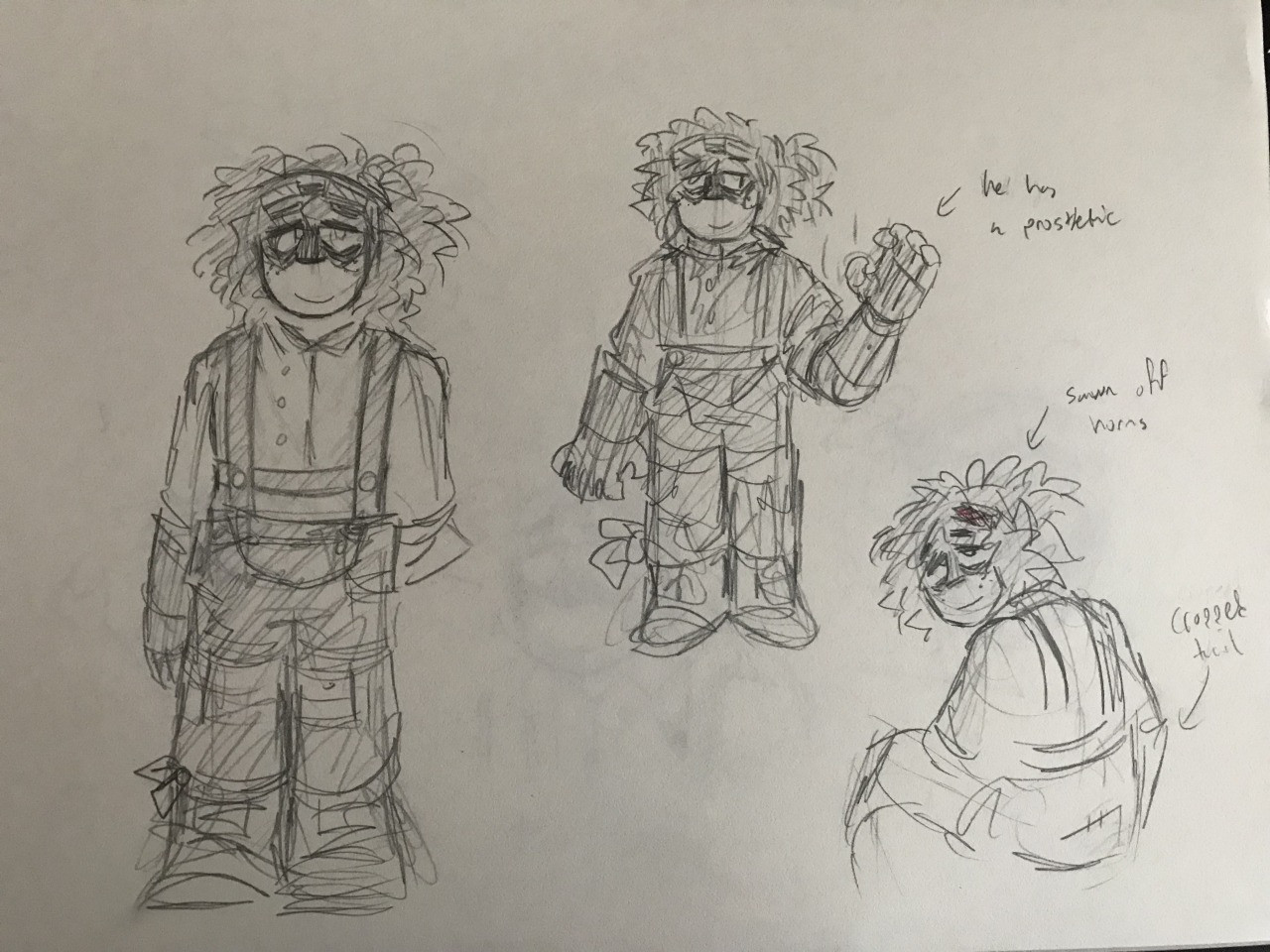
At this point in time, I know Baxter builds a group by taking in other survivors, and I’m toying with the idea of adding elements of community and found family to the plotline. I also know that Baxter is not the most academically inclined individual, but he is capable of sustaining himself in the apocalypse due to his practical cleverness; I may integrate themes of self-worth and societal pressures regarding facets of intellect (booksmart vs streetsmart stigma) into the story, too. I’m not sure where I want to go with it yet, but we’ll get there someday.
Not-Walkers
The doomsday endorsers are a race of intelligent, supernatural creatures, known by many names; not-bodies/not-things/not-walkers, skinliches, fogspawn, fleshmorphs/skinmorphs, guthounds, maneaters, off-skins, skincrooks, skinrogues/gutrogues, skinhowlers, skincrawlers and more. Their specific names are regional, as different communities refer to them as different things. They are inspired by the legend of skinwalkers in indigenous cultures, which are uncanny, malevolent beings capable of disguising themselves as other creatures.
I partially lied when I claimed there were no shapeshifters in Putrid Lockstitch - The not-walkers are capable of shapeshifting, though they are definitely not the same creature as the Bodykin of Thadrofinica. They’re quite the opposite, actually; they are vengeful semi-spirits, driven to a frenzy of violence and bloodlust by anger, greed and appetite. Thankfully, not-walkers are only capable of replicating things they have already seen or heard, so if you keep yourself hidden and ambiguous, then they will not be able to replicate you to an effective extent.
Not-walkers primarily kill their victims through deception and mimicry. They are exceptionally skilled at stealing the faces and voices of others, and are extremely difficult to detect when they are presenting as a perfect replica. They use mimicry to lure their victims into solitude where they can be killed without drawing much attention.
One common tactic not-walkers will use is taking the voice/appearance of a victim’s apparent friends or family. Depending on the circumstances, a not-walker may attempt to beckon the victim into solitude, or lure them out with an urgent tone. If the victim is already alone, a not-walker may try to convince them to allow them inside their home/shelter. If they are successful, a kill quickly ensues.
Another common tactic is mimicking injured stragglers in need of assistance. A not-walker may come up to a victim’s house, begging for help and to be allowed inside. They may also position themselves in a remote area and start screaming for help. Sometimes, this is done with the voice of a victim’s friend or loved one. Once assistance arrives, a kill quickly ensues.
Not-walkers may also disguise themselves as inanimate objects of value. Supplies, weaponry, furniture, or otherwise useful objects that solicit the interest of collectors. They may situate themselves amongst decrepit rubbish, along street curbs, within or around abandoned buildings or any other location they wouldn’t stand out. Once a victim retrieves the object and brings it into their home, the not-walker waits until they are alone or vulnerable to finally strike.
When it comes to actually killing a victim, there are a couple different styles these creatures may exercise. Some may choose to be fast killers, slaughtering a victim as quickly as possible to avoid any further investigation. Others may choose to be cruel killers, wounding and tormenting their victims to lure out more targets when they come to help.
It is impossible to tell how a not-walker actually kills its prey. Bodies are extremely rare to recover from not-walker attacks, so there is barely any evidence available to extrapolate from. Some not-walkers kill for food, consuming the bodies of their prey as swiftly as possible, leaving no remains for recovery whatsoever. Other not-walkers kill as an act of reverence or worship, and tend to do so extremely gruesomely; I will touch upon this later. Some not-walkers massacre to create more of their own; this is not the neatest of rituals. And of course, some not-walkers simply kill for the sake of killing, acting on their thirst for vengeance and loathing for mortal kind. Acts of violence from a place of hatred are always the messiest mortalities to see, after all.
According to many witnesses, the bodies of not-walker victims are unrecognizable; they are always desecrated to such a degree that they are completely indistinguishable from the person they once were. Massacre scenes are decorated with ribbons of tissue, peeled and frayed from the mass of wounds that was once a body. Limbs and organs are broken, torn, stretched and strewn about, covering the area like a sheet of vile paint. Every wound is jagged and riven, suggesting they were delivered by claws and teeth.
It is not uncommon for a not-walker to alter the bodies of their victims - breaking bones, rearranging skeletons and re-sculpting muscles are a characteristic feature of victim remains. Usually, this is done in such a fashion that the victim’s body will appear elongated and uncanny, but there is plenty of variation to the unsightly forms not-walkers will force a body to take.
Oddly, every victim is found completely stripped of any clothing or fabric items (such as bags or rags,) their stolen objects nowhere to be found.
Sometimes, a not-walker will use a victim’s body to propagate more of the population. The delivery of the kill does not differ from the gruesome manner of a typical victim. However, the not-walker will not consume or abandon the corpse once the job is complete. Instead, it will continue to mutilate the carcass, stretching out its limbs and rearranging its tissue until it resembles that of a fellow not-walker. Once the disfiguring is complete, the not-walker will begin to patch up the body with random scraps of fabric. This is usually done with the pieces of the victim’s clothes, but completing the process often requires fetching extra material.
The process of restoration, paired with the time it takes for a not-walker to scavenge for fabric, normally takes several days to complete. Little by little, the corpse is repaired into a brand new body of patchwork. Wounds are mended, holes are filled, cavities are stuffed. After the body is primed, the not-walker prepares to finish the ritual. It tears off a piece of its own flesh, carefully placing it into the body of the victim, and closing the final seam.
For the next couple days, the body is left alone to fester. During the decomposition process, the organic tissue breaks down and soaks into the fabric woven throughout it, fusing the two together. It is at this point, when the tissue is sufficiently fused with the cloth, that the body will regain consciousness as a fresh not-walker.
As you have probably noticed, not-walkers are doll-like creatures made of flesh and fabric. They steal the clothes of their victims for restoration and reproduction purposes.
Background
Not-walkers, as a concept, are thought to have come from folklore. Their stories were most prevalent in remote communities, especially rural locations along the northern latitudes of the globe. According to folklore, their origins are described as the doing of a heartbroken witch, bereaved by a great tragedy. Shocked into grief by the unexpected death of her only two children, the witch attempted to mend their bodies into dolls to preserve their memory. As she descended further into the madness of grief, the witch attempted to revive her children, creating the first not-walkers in the process.
Not-walker stories were meant to warn against messing with the forces of nature. In the witch’s blind pursuit of mending her heartbreak, she tampered with life and death itself; a natural force that should not be disrupted. Rather than restoring the lives of those she had lost, the repercussions of tampering with nature yielded monsters instead, uncanny and vicious. Do not mess with the natural order, lest there be catastrophic consequences.
Not-walkers have existed as cryptids for a long while; throughout history, there are scarcely documented cases of not-walker related disappearances, but never on a sweeping scale. These disappearances are presumably related to the occasional propagation of more not-walkers, since their population well surpassed the original two described in the story. They seemed more interested in killing animals instead of people for food, anyways. Even then, the activity was fairly localized; they weren’t always harbingers of global catastrophe, so what happened?
Well, incidentally, they happened to choose the wrong victim at the wrong time. An unfortunate not-walker picked a member of a particularly vengeful family, which rallied the equivalent of a witch hunt in retaliation for their loved one’s death. Setting out to slaughter the not-walker responsible for the family’s loss, they pledged they would not rest until the culprit was killed. They eventually succeeded, but didn’t stop there; the family, and their supporters, vowed to kill as many of the creatures as possible and deliver justice to the other victims lost to time.
The hunt succeeded voraciously, befalling a sizable portion of the not-walkers' already sparse population. But since not-walkers are creatures of necromancy, they cannot pass on from life so easily. They are dead beings, animated only by extra life force stuffed into a form that should not function; their abundance of energy essentially brute-forces the body into living on. When that body is destroyed and killed, that abundance of life force is released, with nowhere to naturally disperse to.
Trapped upon the mortal plane, the life force accumulates into a cloud of viscous fog. The fog ebbs and flows across the land, circulated this way and that by the weather that surrounds it. But, unlike regular fog, it never absolves itself into nothingness. There is nowhere for this life force to drain away; except, of course, through the bodies of living not-walkers.
Not-walkers who find themselves submerged in the fog are flooded with the extra energy of their fallen peers, strengthening their necromantic forms into a vessel that outright refuses death. They become effectively invulnerable; still susceptible to injury, but practically impossible to kill.
It didn’t take long for the not-walker population to realize this. In the fog, they are safe. And since they are safe, they can do whatever they please. And thus, they waged war against the mortals that hunted them, massacring all they could manage. Soon after, though, they realized this would not last forever, since their fallen peers would only provide a finite amount of energy before they depleted the deposit completely.
And so, the not-walkers devoted themselves to the fog, slaughtering every living creature they came across to replenish the supply of life force, even if it was non-not-walker energy. Consequently, not-walkers immersed in the fog became extremely aggressive and effectively immune to dying, turning them into the apocalyptic massacrists they are known as today. They kill excessively as an act of worship, perpetuating their state of invulnerability in devout ferocity.
Premise
The not-walker fog is transient, periodically engulfing different areas as it is shifted and shaped by the surrounding weather. Not-walkers either choose to migrate with its movement, or hibernate in its absence, entitling non-foggy areas as universal safe zones. Communities of survivors go in and out of lockdown according to the area’s weather conditions, including Baxter’s small yet resourceful little group.
Not-walkers are near perfect imitators, so they are almost impossible to detect; there are only very few reliable signs to tell them apart. The only observable details are as follows:
- Not-walkers are unable to bleed. Hence, two details can be examined with respect to this fact;
- For not-walkers pretending to be injured stragglers in need of help; fresh-looking wounds on a subject’s body may appear bloody, but are not actively bleeding.
- For any not-walker; they do not bleed if they are given a new wound.
- Not-walkers are very alive creatures, by nature of their necromantic origins. Their bodies are very warm with heat given off by their life energy;
- An inanimate object you may suspect to be a not-walker will retain its warmth when left out in fresh air/left in the cold due to this body heat.
Outside of these few details, it is extremely difficult to verify if someone is a not-walker before it is too late.
Baxter took note of these trends early into his days as a fog survivor. In fact, Baxter took note of several not-walker trends, conceiving some clever systems to evade their tricks and ensure his own safety. One such system is his system of ambiguity - on the rare occasion he found himself scouting through the fog, Baxter only ever communicated through sign language or morse code, such that his voice could not be heard and mimicked. Baxter also took on a very ambiguous appearance, covering himself in featureless attire and removing any distinctive features that could further identify him (hence why he is missing his horns and a tail.)
For a period of time, Baxter survived on his own; though this was eventually subject to change. Exploiting his findings of not-walker anatomy, he scouted into the fog for any real stragglers in need of rescue - he ends up meeting other survivors through his escapades, eventually bringing them back to his shelter and gathering up some company. They adopted his clever safety systems, eventually building a self-sufficient community that thrived despite the horrors outside.
Conclusion
That concludes my brief summary of Putrid Lockstitch. I plan on developing this world a lot more in the foreseeable future, since I quite like the direction it’s headed! Usually, apocalypse universes reuse a lot of creature tropes to fit the traditional theme of the genre, but I’ve been having a lot of fun conceptualizing my own doomsday creatures and thinking outside the box! Hopefully, one day I’ll be able to decide on a medium to pursue so I can share it with the rest of the world.