Last updated: 05/27/2026
Overview
The Meta is my fourth worldbuilding passion project - and it’s quite an indulgent one at that! The Meta is the third oldest out of the five universes I’ve been working on. Despite this, it is the second least developed out of the whole group. I created the first character and earliest concepts for an art project in Grade 10, and then promptly forgot about it for several years. I’ve recently picked it back up again, so it’s finally starting to get some proper development!
The original assignment tasked students to investigate potential post secondary programs they could be interested in. Students would then produce an art piece based on their program of choice, ideally modelled off of portfolio requirements. I selected a game development program; the portfolio asked for an original game concept with supplementary prototype assets. This led to me drafting the first ever iteration of this universe; since it was conceptualized through the lens of game design, I believe it would best be explored through a videogame environment, rather than a narrative story or informational encyclopedia. Specifically, it would be a puzzle game with story elements, where the plot progresses as the player solves each puzzle level.
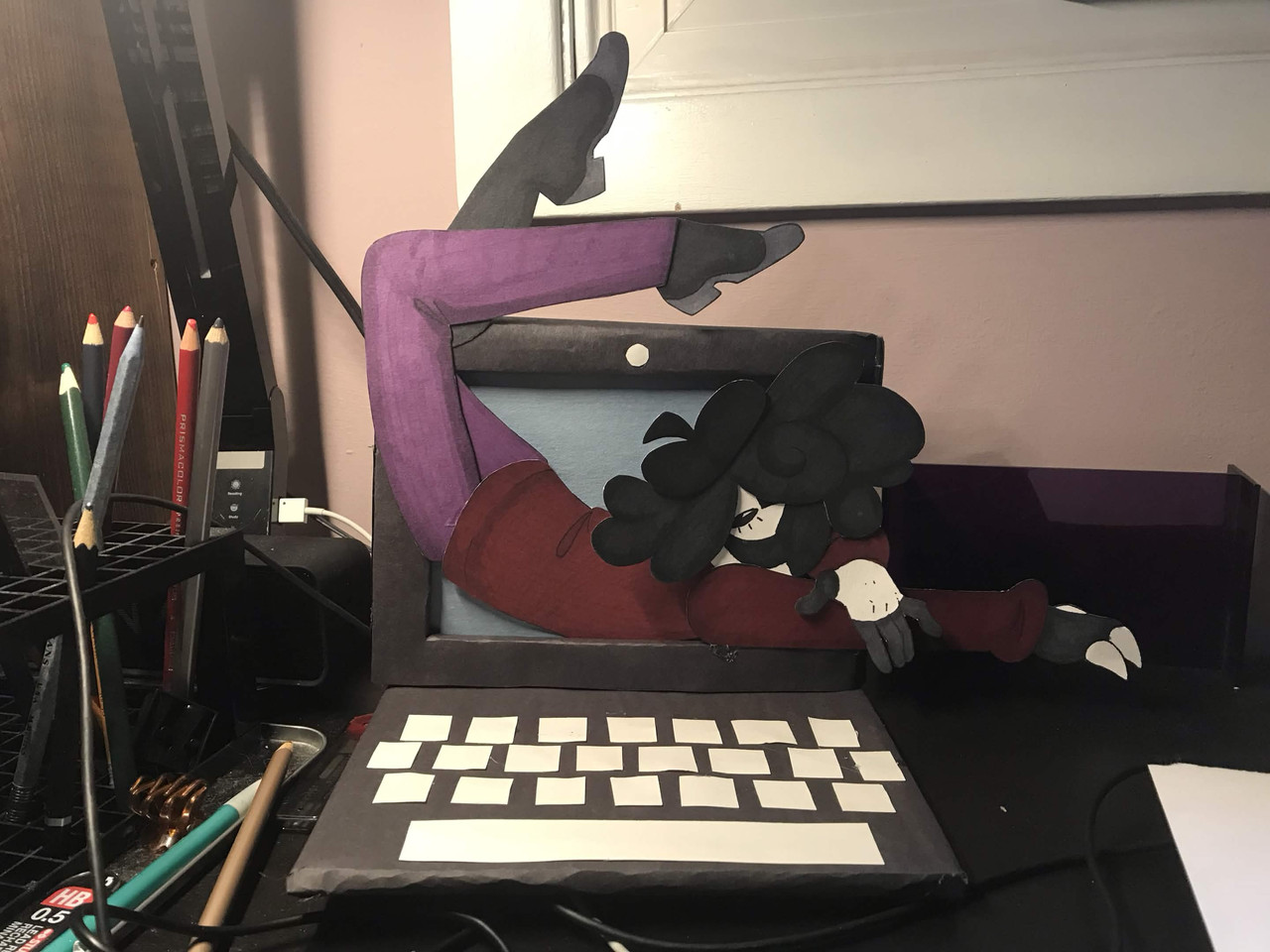
The Meta is an extremely self indulgent universe - I’m a huge math nerd, and I find a lot of facets of mathematics to be very fascinating and quite entertaining to see applied in problem solving. Most of the puzzles would be related to mathematics in some way or another, though it would not be an exclusively ‘math’ game. Most mechanics would be references to mathematical operations rather than forcing the player to actually perform arithmetic or algebra.
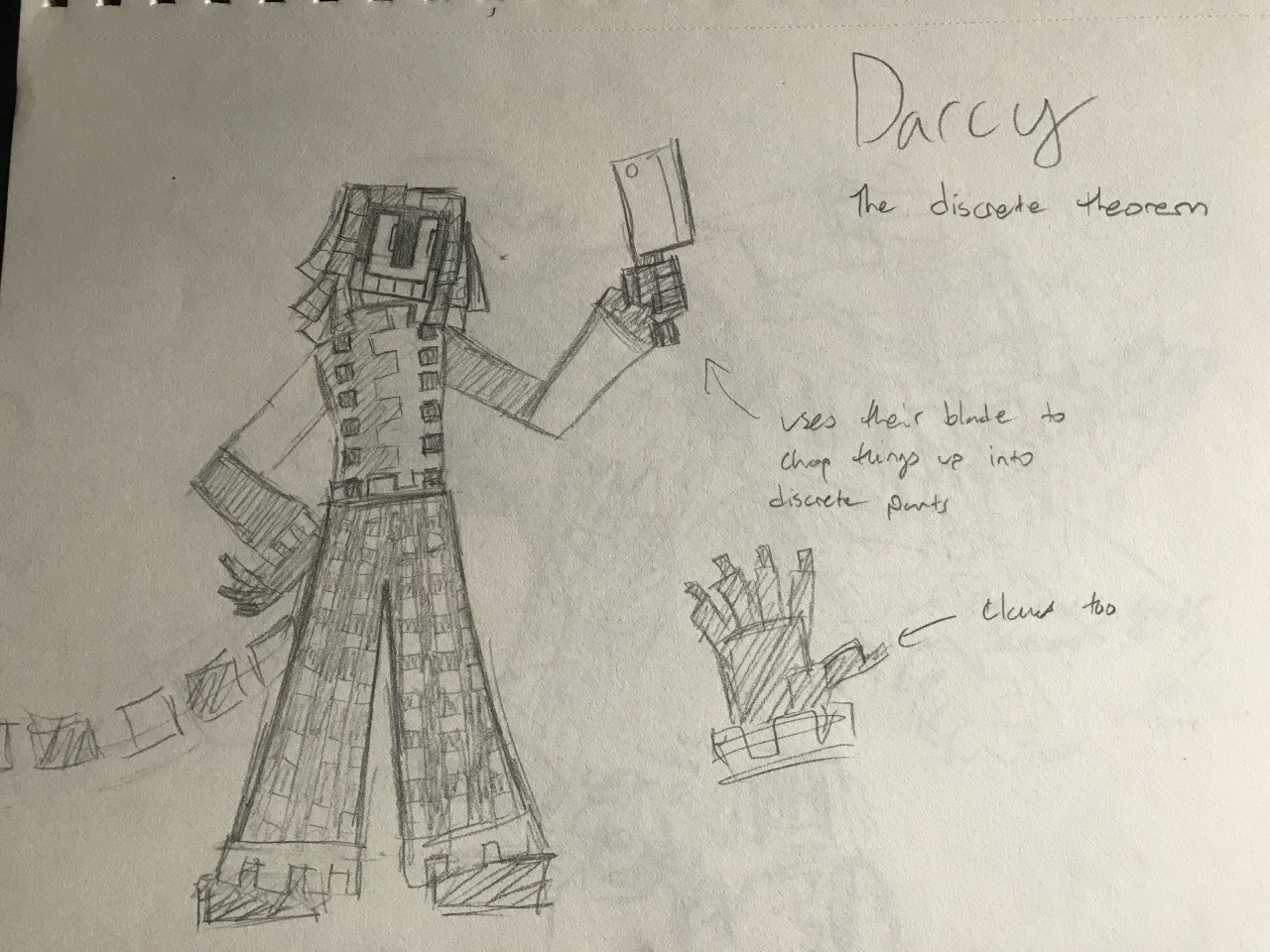
For example, one of the characters I made for the Meta is a reference to discrete or noncontinuous functions. However, this character’s mechanic is anything but mathematical - referencing how discrete functions are ‘chopped up’ into discrete pieces, this character’s mechanic involves chopping up everything they come across. I think they would be interested in chopping up the player character, which the player is tasked with defending!
Most characters would follow the same trend; their mechanics are references to mathematics, but I don’t think the player would need any advanced understanding to progress through the game. However, anyone with such an understanding (like myself) would be able to recognize and appreciate each reference.
Background
The beings that inhabit the Meta are known as theorems. Essentially, a theorem is any system, concept or rule that is internally consistent made personified. Every theorem's body has a set group of abilities related to the concept they are personifying, mirroring the properties of their origin. Each theorem comes from a certain branch, which encompasses a specific concept in mathematics. There are separate branches for every section of mathematics; algebra, arithmetic, boolean logic, etc.
The Meta is a very abstract world composed of floating geometric shapes, grid spaces and plenty of other low-poly bizarrities. It is split into a variety of regions built off of each branch; theorems tend to stick within their own native region. I don’t have a great idea of how the scenery would look outside of that. Like I said, it’s very abstract!
The branches I mentioned are, quite literally, branches. They are thick structures of abstract concepts (areas of mathematics) that stretch off into the distance from around a single conceptual point (mathematics itself). The thinner the branch, the more specific the concepts contained in the structure become. If a branch becomes thin enough that it fits only one concept, it breaks off and becomes a new sentient theorem.
A theorem’s job is to explore these branches and whittle them down to produce more theorems. All theorems work together to distinguish consistent patterns in the branch structures, ‘carving’ them out of obscurity and hopefully discovering a strain that can be thin enough to snap off and produce a theorem. This system is an analog to how mathematical concepts can be used in conjunction to discover brand new mathematical properties.
Premise
The main character of the Meta, the player character, is a concept branch that prematurely broke off from the rest of the system. Their name is Draftsman, and they are the unfinished theorem. Since they are unfinished, they are still functionally ambiguous; this means they are capable of changing their abilities to whatever they can replicate from other theorems. This translates in-game to the ability to ‘borrow’ other characters’ mechanics, so the player is given an array of puzzle-solving abilities to choose from.
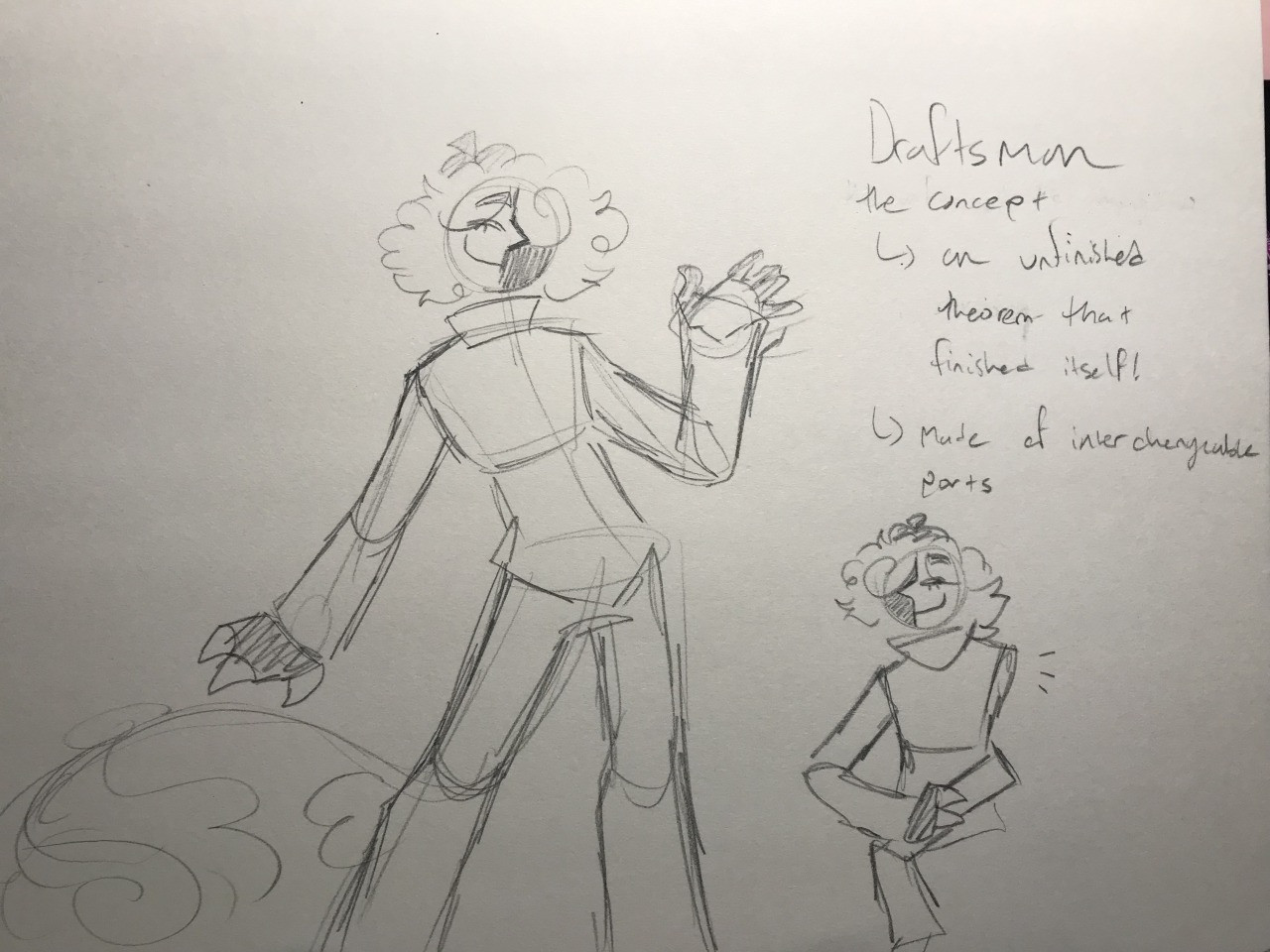
The objective of the game is to assist Draftsman in finishing themself as a concept - along the way, you get to explore the Meta’s world, borrowing and exploring other theorems as you search for the parts that fit you best. Draftsman addresses the player directly, breaking the fourth wall to ask for help in achieving their goal. Due to their ambiguous nature, they allow the player to take control of their body as an exercise of ‘borrowing’ the mechanic.
I imagine as the player progresses through the levels, the scenery and aesthetics would change with each new region. It would be a multi-stage game; new faces and new mechanics would surface in each area. Like I have mentioned, the regions are based on their parent branch of mathematics, so certain types of theorems would be categorized together by area.
Conclusion
I think the moral of the game will be that ambiguity is okay - you don’t need to know exactly who you are, and you don’t need to be internally consistent, as long as you really feel like you in the end. Draftsman ends the game by announcing that they are happy with what they are, embracing their ambiguity to the fullest. They reject all the borrowed mechanics, returning them to their owners they had met along the course of the game. This includes the borrowed mechanic where the player takes control of them - in the very end, Draftsman and the player officially disconnect, and Draftsman thanks the player for their help along the way.
And that’s my brief summary of The Meta! Its worldbuilding is a lot less complex than some of the others, and I think I like it that way. The abstract simplicity makes it fun to exercise the non-intuitive part of my creative brain, and I’m pretty happy with the direction it’s going! Maybe one day I’ll make it into a playable game, but I think that’ll be quite far off into the future.